Sunday, 12 December 2010

Signs of the Times: Autumn #1

Apologies for the recent absence of posts here - the extremely bad winter weather and closed offices has meant that our PC was tied up with home working and there's also been lots of work to do at home in preparation for the festive season - but I'M BACK!

More comparisons between the British countryside of today and that from 1959-1961 in the paintings of Charles Tunnicliffe in the Ladybird "What to look for..." series of books.


"Autumn is a second spring when every leaf is a flower."
Albert Camus

Well, when I started out on these blog posts based on the four Ladybird books in the "What to look for in..." Spring, Summer, Autumn and Winter series, I didn't expect to be starting the Autumn book when it was nearly the end of November and there was snow lying thick on the ground outside. But hey ho, sometimes the business of life intrudes. I did start the Spring book a little late and I've never quite managed to catch up but I'm happy to carry on and try to finish Autumn and Winter books before the end of March!

Here's the cover of the Autumn book, a lovely image that we'll revisit in due course:

Copyright: Ladybird Books

The Autumn book in the series was first published in 1960. To set the scene for the posts to follow on the 24 pictures making up the book, here are the inner cover notes that provide an overview of the book's contents:

"There are many, many things to look for in autumn, just as there are at any other time of the year. You will, of course, soon find such things as blackberries and hazel nuts, but if you know where to look, you might also find the nests of the wood wasp hanging from twigs, or a bumble bee's nest in the bank - in which you might even discover a field-mouse curled up. You can look for the large flocks of various kinds of birds, some in their young plumage, others fully adult, and some still half-and-half; and sometimes you will find all the males together in one flock, and all the females together in another. This book will tell you many other interesting things that you can see."

So, let's go and have a look at Autumn, shall we?

Copyright: Ladybird Books

Autumn Picture 1


This first autumn picture from 1960 is a classic view of a traditional post-harvest scene. In the foreground, a stoat is running past from field mushrooms. Wood pigeons are feeding on grains from a harvest of oats (according to the picture's accompanying text) has been stacked to dry in bound bundles known as "stooks", waiting to be threshed in the field or gathered up for stacking. Once dry, these stooks would need to be threshed to separate the grain from the stalks.

Traditionally (historically), this threshing would have been a manual operation, perhaps on the ground using flails, subsequently replaced during the mechanisation of agriculture by a separate threshing machine. By 1960, when the Autumn book was published, the era of the separate thresher was coming to an end as new-fangled “combined harvesters”, or what we now call combine harvesters, were being introduced, mechanising the whole harvesting and threshing (but not baling) processes into a single piece of agricultural machinery.

Interestingly (and thanks to Christine H for pointing this out when I discussed this subject with her recently), on many small crofts in Shetland, harvested grain crops are still formed into stooks, and I found an interesting blog, Laplandica.com, which describes this in words and a picture. My Dad, born in the 1930s, well remembers seeing the appearance of stooks at harvest time when he was growing up in Ayrshire, and their subsequent formation into haystacks (were they calle dhaystacks even when they were for straw?). He remembers that there was a real knack to building them up, such that the upper bundles that formed the pitched “roof” of the stooks both kept the valuable grains dry and also managed to shed any rain in a way that kept the rest of the stack dry.

The wood pigeons in the picture are presented as engaged in the activity that raises such enmity from farmers, eating the bounty of harvest! My old AA Book of British Birds says of the wood pigeon (Latin name: Columba palumbus): “No bird is a greater enemy of the British farmer than the gentle-looking wood pigeon, largest of our pigeons and doves. Practically all year round, it ravages crops...” Consequently, the wood pigeon is also one of the most persecuted wild birds in Britain. Despite the high level of shooting to control their numbers, however, the population of wood pigeons has increased more or less steadily and steeply since the mid 1960s, as shown by the British Trust for Ornithology:


Of this increase, the BTO says: “The spread of intensive arable cultivation, especially of oilseed rape, which has been shown to promote overwinter survival, may explain the rise in numbers.” For the UK as a whole, the wood pigeon population has increased 160% since 1967. You can read more of the story here.

The stoat running across the stubble field, distinguished from the closely related weasel by its greater size and the black tip to its tail, is probably hunting for field mice which have been left bereft of shelter. The Mustelid family to which it belongs is a really successful part of the Order Carnivora. As well as stoats, the Mustelidae, a mammal family found world-wide, includes weasels, polecats, otters, badgers, martens and skunks. Like all the members of the Mustelid family in Britain, the stoat (Mustela erminea) is an extremely agile and capable predator, feeding mostly on small rodents, rabbits (and hares?) and birds. My Collins Field Guide, “The Mammals of Britain and Europe” (by David Macdonald and Priscilla Barrett) describes the killing technique of the stoat as a: “precision bite to [the] back of [the] neck”. No messing about there...

The Great British Public sees stoats regularly on television, or at least their pelts or fur. The stoat, as many of you will know, has fur that turns partly, or in northern regions wholly, white in winter, triggered by a combination of falling temperatures and genetic inheritance. That white pelt, with its little black-tipped tail, made stoat fur important for the fur trade as “ermine”. And that is what traditionally provided the white fur trim to the red robes worn by the Peers in the House of Lords. Not the nicest role for a stoat to play, admittedly, but a very high profile one, nevertheless.

The Joint Nature Conservation Committee’s Review of British Mammals provided an assessment of the conservation status of stoats. Sadly, the principal reason we have an estimate of the British population of stoats (around 462,000 in Britain, of which 180,000 in Scotland), as with a number of other species, is the National Game Bag Census, in other words, the reports by gamekeepers of the numbers of stoats they have killed. It seems that humans are generally pathologically incapable of sharing their environment with any wild carnivorous mammals. Pre-historic Britain had large predators with sharp teeth (wolves, bears), which humans eradicated, both as perceived predators of people (although there is little evidence that wolves systematically hunt people) and also competition at the top of the food chain, including preying on domesticated animals.

Systematic hunting and killing, and habitat destruction (principally deforestation) made their eventual extinction in Britain inevitable. That left the “middle-ranking” smaller predators, such as otters, the red fox, stoats, weasels, wild cats and pine marten, polecat and, to some extent, the badger (it has a much more varied diet than solely carnivorous). None of those species posed any direct threat as predators of humans but they have all been persecuted to greater or lesser extents, particularly over the last couple of hundred years and, it seems to me, particularly from Victorian times onwards, as predators of game species (grouse, salmon, pheasants, etc) favoured by the wealthy and powerful.

The JNCC review reported that, at the start of the 20th Century, stoats were “still abundant despite relentless persecution”. Then, however, populations were then “severely reduced for 15 to 20 years following the outbreak of myxomatosis” (which severely reduced the rabbit populations which form an important part of the stoat’s diet). From 1960 to 1976, “the number of stoats killed, as recorded in the National Game Bag Census, doubled, but the number killed in northern areas declined again after 1965”. However, since the mid 1970s, the number of stoats killed by gamekeepers throughout Britain has declined again. Reasons for this decline are unclear. Since the number of rabbits killed nationally has continued to increase, a further rise in the stoat population might be anticipated. However, “any rise in fox numbers may be a contributory factor to the failure of the stoat population to increase in response to rising rabbit numbers, since increasing fox numbers can lead to a decline, or even local extinction, of stoat populations”. Ecological relationships are complicated, aren’t they? But then, I never claimed this was going to be easy.

I’ve nothing much to say about the rather vaguely drawn field mushrooms in the picture – there are much better fungi examples and stories in the pictures to follow!

Friday, 26 November 2010

Down in Brick Lane, in a basement retro clothing sale, the 1960s and 1970s live on...

I wanted them all...


... and you should see the psychedelic tie I came away with instead... maybe another time!

Signs of the times: Summer #24 - and a farewell to all that!

More comparisons between the British countryside of today and that from 1959-1961 in the paintings of Charles Tunnicliffe in the Ladybird "What to look for..." series of books.


"See how steadfastly they stand
the cormorants of Lympstone Sand
in ranks, like booties on parade,
with all their better parts displayed.

They face up nobly to the wind
and neatly tuck their tails behind
and number off from left to right.

Their hearts are true. Their eyes are bright.
They never twitch or jig about
But hold their heads high, chest puffed out
and perk their bills up, if you please,
to smackbang forty five degrees.

These cormorant of Lympstone Sand
defer to none in all the land
nor ever let their bearing flag
lest some fond souls might think them shag."

Ralph Rochester, "Cormorant"


(Copyright: Ladybird Books)


Summer Picture 24
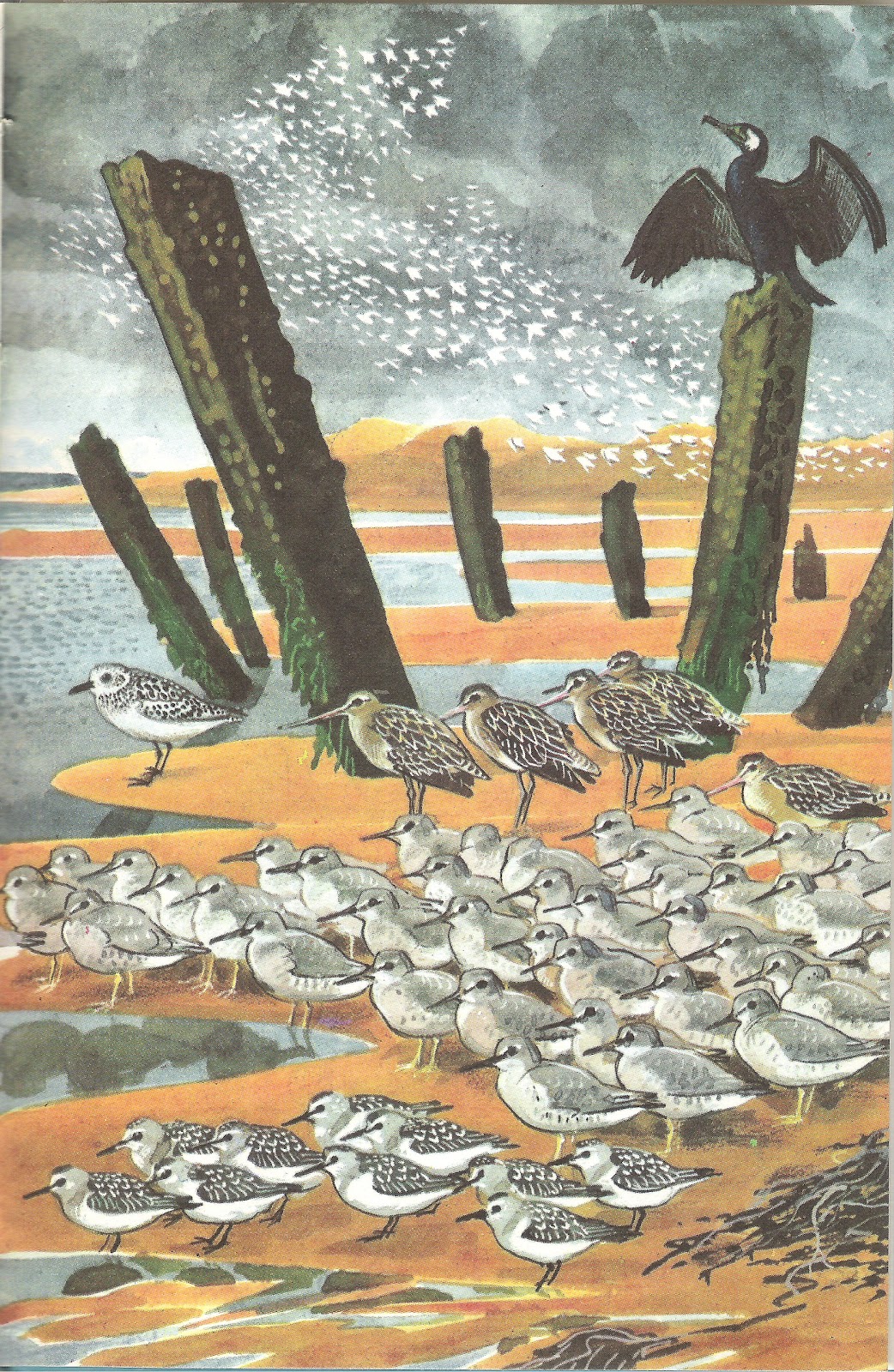
Oh, why has Summer felt like such a long season (in blogland, at least)? Here we are in November and I have FINALLY reached the final picture in the Ladybird Summer book! I find it interesting that the final three pictures have been around the seashore. I think that old Charles Tunnicliffe was well aware that, in terms of the approach of Autumn in Britain, as well as the harvest, the shortening days and the fall of dead leaves, the arrival of the birds that will spend the winter here is another key indicator – and they must, of necessity arrive first at the coast! While many species, like the redwings and fieldfares, will move on inland, the wading birds and many of the waterfowl will stay largely on the coast where, even in very cold winters, they will generally be able to feed on our many large estuaries. Hence, the selection of this image as the closing chapter of Summer in this (somewhat extended!) coverage of the Ladybird Summer book.


This picture is exclusively about birds – waders and waterfowl, gathered around the half buried ribs of a large wooden ship. A cormorant stands on one of the ribs drying its wings, lifting them into a breeze. Left of the centre of the picture, a solitary grey plover stands near some bar-tailed godwits, under the wooden ribs. Below them, a larger flock of knots stands, with a large flock of knot banking and turning against the slate grey sky in the background. In the foreground, a small flock of young sanderlings has landed down by the waterline.


I’ve always been really rubbish at identifying wading birds, especially the ones that arrive here in the winter, so it is lucky that the book provides text to tell me what is what here. In fact, the cormorant (which is not a wader anyway) is the only species here that I’d be confident in identifying without recourse to a bird book! So let’s start there…


A common, native, year-round resident fish-eating waterbird, the cormorant (Latin name: Phalacrocorax carbo) is a species that can raise high passions amongst the angling fraternity, where it is perceived to be a major consumer of the fish species also sought by trout fishermen. My old AA Book of Birds describes the cormorant, rather colourfully, as follows:

“Voracious, large-beaked, reptilian in appearance, the cormorant can consume more than its own weight of fish in a day.”

It’s a great line but it isn’t true (although the belief is probably still widespread among anglers. Managing conflicts between predators of commercially important prey species and the human exploiters of those prey is one of the key challenges for conservation in the UK (hen harriers/ red grouse, or peregrines/ racing pigeons also spring to mind) and the importance of good, sound, scientific evidence in developing policies to tackle these conflicts can’t be underestimated. And there has been quite a lot of research into the importance of cormorants as predators of stillwater fisheries in Britain, for example, from Loch Leven in east central Scotland. What is clear that male cormorants weigh 2-3 kg, while females are in the range 1.7-2.5 kg, and they usually require 4-500g of fish a day, well less than their own body weight. If you want a good explanation of the issues and how fishery managers are recommended to deal with their cormorant “problem”, there was a very useful fact sheet produced in England by the Fisheries and Angling Conservation Trust, along with a wide range of environmental, angling and conservation organisations. The most up-to-date information on trends in cormorant numbers is provided by the British Trust for Ornithology which suggests that the trend is for an increasing population, with over 9000 breeding pairs in the period 1998-2002. The BTO also says: “There was a 10% increase in the UK population between full surveys in 1985–88 and 1998–2002 … Trends during 1986–2005 show decreases in Scotland and in northeast and southwest England, but no trend in Wales, and steep increases inland in England and in regions bordering the northern part of the Irish Sea... Reasons for recent decline probably include increased mortality from licensed and unlicensed shooting.” The overall increase in population size was 37% between 1995 and 2008:


 Coming back to the bird in this picture, unlike many waterbirds, the cormorant’s plumage is, somewhat inconveniently for a diving, fish-eating waterbird, not waterproof, hence the reason that they often stand on rocks or, as here, other waterside structures, wings out-stretched to dry off in the wind after fishing.


The solitary Grey Plover (Pluvialis squatarola), on the centre-left of the picture is, for all its drab winter plumage shown here, a representative of a rather interesting species. I can’t do better than quote, again, from the AA Book of Birds: “The grey plover, drab in its grey-brown winter plumage and sometimes looking the picture of dejection as it waits on the mud-banks for the tide to turn, is a vastly different bird on its breeding grounds in northern Russia and Siberia. There, in its handsome summer plumage – grey-spangled, white-edged and black-breasted – it plunges and tumbles acrobatically in the air and will boldly attack marauding skuas that come too near its nest.” So, there’s more to this little tundra-loving, Cossack of a wading bird than meets the eye…


The BTO reports that around 53000 grey plover spend their winter in Britain, with perhaps 70000 passing through on migration and that, globally and in Europe, the species is not of conservation concern (although it has an “amber” warning status here in the UK – although it doesn’t say exactly why! Just something about Britain having an important non-breeding population). In winter, it feeds on our estuaries and coasts, mostly on marine worms, crustaceans and molluscs. From the above, I would say it seems unlikely that it has declined since the publication of these Ladybird books, but it is hard to be sure from the published evidence I can find. I did find, in the “Birds of the Western Palearctic”, however, that there has been a major recent increase (recent in their terms, being in the 1990s!) in the grey plover population of north-west Europe, this presumably including Britain.


Standing under the cormorant is a flock of five bar-tailed godwits (Limosa lapponica), which will have arrived on this British shore from Scandinavia or northern Russia, again to spend the winter here (or perhaps in transit to a destination much further south, using the British estuaries as staging posts, to rest and refuel on their migration flight. Like the grey plover, another wading bird that appears drab in winter plumage, the male bar-tailed godwit has a magnificent pale chest in the summer breeding season. The “Birds of the Westrn Palearctic” reports maybe 60,800 individuals in Britain in winter, while the BTO reports 62,000 winter birds. This species is not of conservation concern at European or Global level and its population may have increased within its breeding range. Interestingly, the BTO reports that, quite remarkably, Bar-tailed godwits from Alaska over-winter in New Zealand, but make the 11,000 km journey without stopping, which takes around seven days, probably the longest non-stop journey of any bird.


The largest flock on the shore is the small pale grey wading bird known as the knot (Calidris canutus). Yet again, this tiny wader makes enormous migratory journeys, from their breeding grounds in the far north of the Arctic in huges flocks to over-winter further south, arriving on Britain’s coasts in late summer and on into October. Many are only here on passage to further south, but huge flocks do remain for the winter. In fact, the BTO provides a figure, for the British wintering knot population, of 284,000!

What Charles Tunnicliffe has done in this picture is to include the knot, both as a flock in the foreground, but also as a massive wheeling flock in flight in the background, against the slate-grey sky. I grew up watching such unbelievably massive flocks of knot as a common winter sight on Aberlady Bay, east of Edinburgh, where I spent many cold winter and hot summer childhood days plodding across the nature reserve, my “Boots the Chemist” 8x30 binoculars in hand. Knot form these massive flocks, presumably for the same reasons as starlings are thought to do so – to reduce their individual chances of being taken by a raptor, most likely a peregrine falcon, and maybe because, by spending time roosting together, they are able to reduce heat loss and hence conserve energy during cold weather. And just like starling flocks, knots in flight wheel and bank apparently nearly simultaneously, with the effect that they flash light as you see all of their undersides turn towards you at once, the almost disappearing as they wheel back in the opposite direction, their darker backs against dark winter clouds. And the flock produces a hissing of wings if you are lucky enough to be near one in flight. One of Britain’s great estuarine spectacles, in my view, and one that is worth seeking out if you have the chance.


And so, and so, to conclude this series of blogs on the Ladybird Summer book, one final candidate species, in the nearest foreground of the picture, a small flock of ten young sanderlings. Yet another wader that breeds in the Arctic and comes to British coasts in the winter, where it prefers sandy shores, the sanderling (Canutus alba) can be described as a small pale wader that scurries along the tide line, restlessly looking for food, in the form of the small crustaceans of sandy beaches. In reading around for this article, I discovered a little bit of biological trivia that ties in with this distinctive movement of the sanderling: according to the BTO, “Uniquely amongst British waders, the Sanderling has no hind toe - giving it a distinctive running action, rather like a clockwork toy, as it darts away from incoming waves on the beach edge”! Perhaps 21,000 birds spend the winter here and the BTO describes little conservation concern over the status of this species in Britain, Europe or globally. Nice to end the Summer book and its blog posts on a small positive note!

Thanks for reading along so far, and for all the interesting comments. Hopefully, you’ll stay with me as I head into the Autumn book 9and try to catch up with the seasons bit – I DID start the Spring book late and have been playing catch up the whole time! On, on to Autumn (p.s. It is snowing heavily outside tonight! Did anyone see where Autumn went?)...


Thursday, 11 November 2010

Signs of the times: Summer #23

More comparisons between the British countryside of today and that from 1959-1961 in the paintings of Charles Tunnicliffe in the Ladybird "What to look for..." series of books.


“Kali frae Bali in classroom three,
 Swallaes her chippataes wi a cup o tea.
Dod Jean an Donna sit doon tae dine,

On a parten an a labster frae the ocean brine.”


From: "Doric Food Rap" by Sheena Blackhall


(Copyright: Ladybird Books)


Summer Picture 23
Here we are again, still at the shore and in a rock pool AGAIN! I’m not really sure what the purpose of this picture is in the set of Summer pictures as we’ve looked at rock pools already on a couple of occasions. These later pictures are meant to be taking the reader towards Autumn (and the next book in the series), when the rock pooling summer holidays season is long gone…

My, this is a busy rock pool full of crustaceans, with a large lobster, an edible crab, a hermit crab inhabiting an old common whelk shell, a large prawn and a smaller shrimp (in the bottom right). I can’t tell what species the little shrimps/prawns belong to, so, other than to note that there are unlikely to have been significant declines in these species in the last 50 years (just my professional opinion!), I don’t intend to say more about them here.

The lobster shown here is a member of the famous, gastronomically-popular “common” lobster species(Homarus gammarus), for which Scotland’s rocky coastline supports a small but, given the high commercial value of individual lobsters, significant commercial fishery. The Scottish Government publishes annual fishery statistics, including a report of the total tonnage of lobster landed. In 2009, 1100 tonnes of lobsters were landed at Scottish fishing ports, little changed from the previous few years. For comparison, the 1960 fishery statistics reveal that 889 tonnes of lobsters were landed in Scotland by British and foreign vessels, more or less the same as in 2007, so perhaps lobsters are fished at a level that their population and productivity can tolerate, there apparently being little change in the last 50 years in the weight removed by the fishery in Scottish coastal waters. In its deep, lower shore rock pool, this particular lobster may well be safe from such fisheries but not necessarily from hand-collecting by divers. Lobsters in UK waters may be found down to about 60 metres depth.

The edible crab (Cancer pagurus), the one that has a shell that looks not unlike a pie crust (!), is also a widespread species around Scotland’s coast, which also supports a significant commercial fishery. In Scotland, the edible crab is also traditionally known as a "parten" or a "parten crab" - I only just found out that the word "Parten" in Scots Gaelic means "crab"!

The most recent fishery statistics published by the Scottish Government show that 9500 tonnes of edible crabs were landed in Scotland by UK vessels. By comparison, 1960 fishery statistics for Scotland indicated that 32,556 British hundredweight, or 1654 tonnes, of crabs were landed. Now, unlike lobster, the modern edible crab catch is much larger (nearly six times higher) than the 1960 figure. This may indicate that the fishery was underexploited in 1960, compared to the level of fishing it could tolerate. It might also indicate that the fishery has become more efficient (most of them have – I once read that there is an estimated 2% per year improvement in fishing efficiency as a result of “technological creep”). Without contradicting that previous statement, it might also mean that the edible crab fishery is taking more crabs out of the system than is sustainable in the long-term, although the figures from 2005 – 2009 are relatively stable, so who knows? I really don’t know very much about how we regulate shellfish fisheries in Scotland – there may or may be a quota for edible crabs.

Hermit crabs, of which there are several species in British coastal waters, are well-known for their habit of protecting their soft bodies within the old shells of dead gastropod molluscs (“snails”) such as, here, the common whelk Buccinum undatum. As they grow they have to move into increasingly larger shells and as a result they have been used in many choice and competition experiments by ecological researchers. I think hermit crabs might just be one of the most popular elements of rock pool fauna for young children when they go rock pooling (I speak from distant personal experience). There’s something very entrancing about their lifestyle, with its recurring need to keep finding a new home.


Saturday, 6 November 2010

The fallacy of cheap anything! *sweary alert*

This isn't my normal subject area for blogging but I was shown this last night and wanted to share it, not least because (A) it is fantastically funny and, (B) it shows how effective satire can be at highlighting how much we are being conned by, in this case, big business (and even more precisely, in this case, a certain budget airline). In fact, probably much more effective than a normal journalistic approach, as it pokes fun and pricks the skin of the liars!

I have heard and enjoyed these three gals on and off for years on Radio 4 and I wasn't aware that they were still treading the boards, let alone as effectively and comically as this! (Mum - if you are reading this, and I'm pretty sure you will, there's sweary stuff - but it is funny and in a good cause!).

Enjoy!

Wednesday, 3 November 2010

Signs I Like #15

This is Scotland...
Heaven forbid that we should actually encourage
anyone to play any sport or take any exercise on their local green spaces.
Got to keep it neat and tidy after all!
And I mean, we wouldn't want to encourage that nasty, brutish, noisy,
Celtic shinty nonsense now, would we ...?

Signs of the times: Summer #22

More comparisons between the British countryside of today and that from 1959-1961 in the paintings of Charles Tunnicliffe in the Ladybird "What to look for..." series of books.


“With blotched brown uppers and undersides light gray
They feed on sea weed beaches all the day
Some times in pairs or small flocks though seldom one alone
These little wandering birds called Turnstone.”

Francis Duggan, from “On seeing a pair of turnstone”


(Copyright: Ladybird Books)


Summer Picture 22
The last three pictures in the Ladybird Summer book, this one and the following two are hardly typical Summer scenes, although this picture and the final one are definitely meant to represent some transition to Autumn (as you’ll see again in a couple of posts’ time). This picture is a relatively simple scene, with a flock of little brown, black and white wading birds, called turnstones, foraging through some brown seaweeds, or wracks (knotted or egg wrack, bladder wrack and saw wrack). In the background, another flock of turnstones is flying away, looking like mini-oystercatchers. Some common mussels (sometimes called blue mussels) are visible under the wracks.


The turnstone (Arenaria interpres) is a common bird on British shores in Winter, as well as a passage migrant recorded in Spring and Autumn. As my old "AA Book of Birds" says of this species: “The greatest numbers gather on rocky and stony beaches, where the seaweed covers a rich supply of food.” The name “turnstone” comes from their habit of flipping over stones, sticks, shells and seaweed to uncover their prey of sandhoppers (the little jumping shrimps you commonly see when you move seaweed or driftwood on the tideline), little shellfish, insects, young fish and carrion, and they have also been recorded as eating bird’s eggs. They can turn over stones nearly equal in weight to their own body. The foremost individual in the picture is still in summer plumage, while the others have clearly moulted to reveal their more drab winter colours. In summer, nearly all the turnstones that have over-wintered in Britain return north to the Arctic to breed, so these birds in the picture are either on passage or have arrived here to over-winter.

My usual source of trend information of birds for this blog, the British Trust for Ornithology, unfortunately doesn’t have an entry for this species. But my bird book, “The Birds of the Western Palearctic” reports that the British wintering population is a minimum estimated 44,500 birds. It also suggests that there is no real idea of the total European population as many birds inhabit remote unsurveyed rocky shores of Iceland, Ireland and Norway. Since no sources that I regularly access for this series of posts provides any indication of a decline, I thought I’d be unable to comment on the status of the turnstone. At the last minute, however, coming unbidden through the postal system, like the US 7th Cavalry coming over the hill in the nick of time (but without the unfortunate anti-Native American connotations of that historical analogy, obviously!), a report arrived – the 2010 State of the UK’s Birds report. Produced by a long list of conservation agencies and bodies (including the Royal Society for the Protection of Birds and the British Trust for Ornithology), this indicates that between 1981 and 2007, the turnstone overwintering population in the UK has increased by some 17%, although in the last ten years there has been a 6% decline.


I’m not going to say much about any of the brown wracks or the common mussels – they are all very common species, likely all still to be doing very well, thank you very much, and all deserve more attention than I can give them here. If you want to look for yourself, I recommend once again that you look at the MARLIN website (Marine Life Information), where you can find information on the distribution and biology of these species.